
Claroty xDome vs CTD: Cloud or local? Architecture analysis for your OT network
At SIXE we have been dealing with infrastructure, networks and security for more than 15 years. We have seen everything from PLCs connected “a la brava” to the internet, to hospital networks where a smart coffee maker could take down a critical server. So, when we talk about Industrial Cybersecurity (OT) and IoMT (Internet of Medical Things), we don’t marry just anyone. But, if you’ve gotten this far by Googling, you probably have a major name mess. What is xDome? what is CTD? which one do I need? Don’t worry, today we’re putting on our engineering overalls to explain it to you clearly.
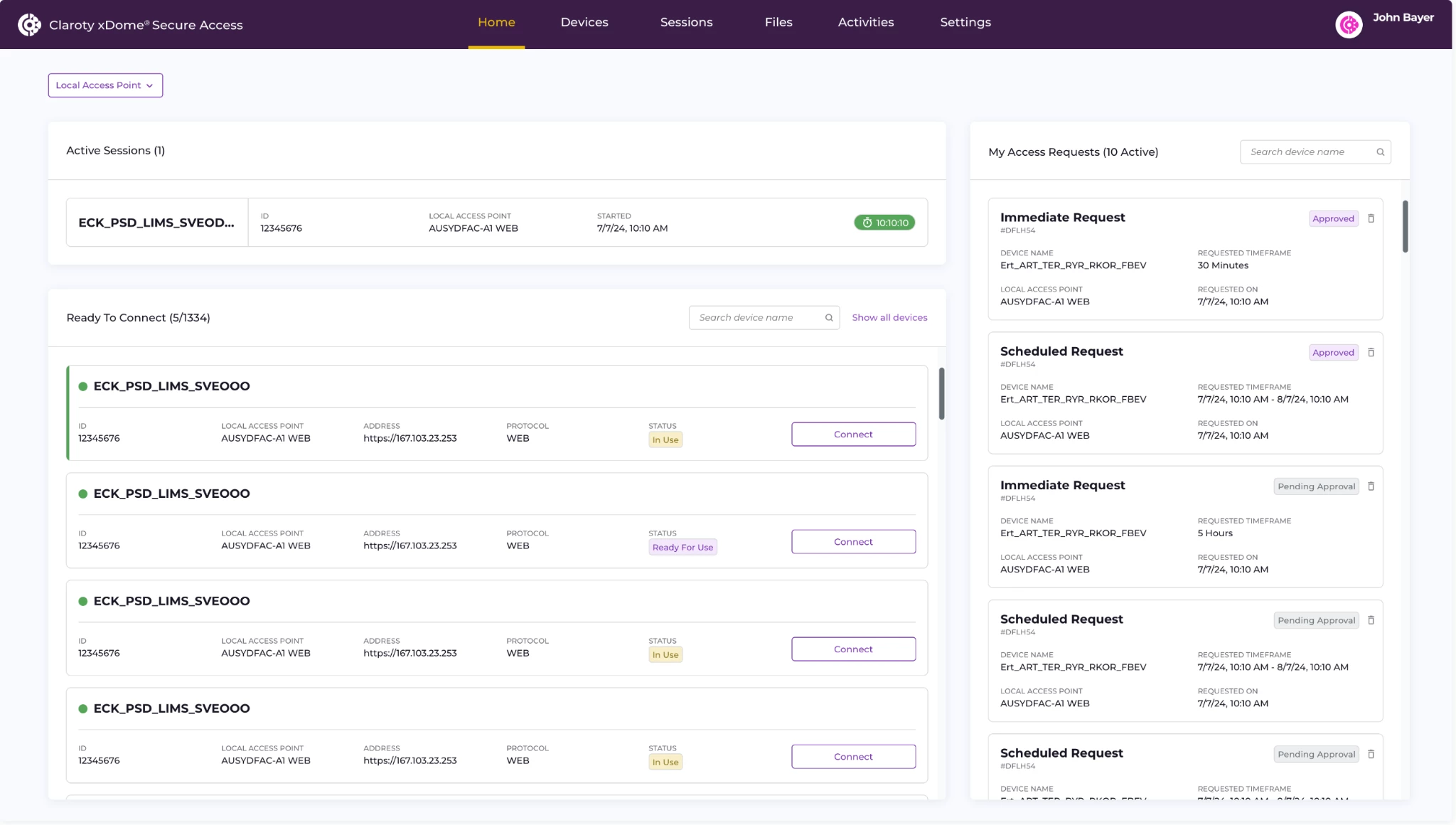
The big question: What is the difference between Claroty CTD and xDome?
This is the million-dollar question. Both solutions aim for the same thing: total visibility and protection of your industrial environment, but their architecture is radically different.
1. Claroty xDome (The future Cloud-Native)
It is the SaaS evolution. xDome is designed for companies that want to take advantage of the agility of the cloud without sacrificing security.
How does it work? It is a cloud-based solution that performs asset discovery, vulnerability management and threat detection.
The best: Deploys lightning fast and scales beautifully. Ideal if your organization already has a “Cloud First” mentality and you want to manage multiple sites from a single pane of glass without deploying tons of hardware.
2. Claroty CTD (Continuous Threat Detection – On-Premise)
It is the classic heavyweight for environments that, by regulation or philosophy, can’t (or won’t) touch the cloud.
How does it work? Everything stays in-house. It’s deployed on your own local infrastructure.
The best: Total data sovereignty. It is the preferred option for highly sensitive critical infrastructures (energy, defense) where data does not leave the physical perimeter under any circumstances.
SIXE’s advice: There is no one “better” than another, there is one that best suits your architecture. At SIXE we perform a thorough analysis before recommending anything.
And what does Claroty Edge have to do with all this?
Sometimes you don’t need to deploy a complete continuous monitoring infrastructure from day one, or you just need a quick audit to find out “what the heck I have connected in my plant”.
Claroty Edge requires no network changes (no SPAN ports, no complex inbound TAPs). It is an executable that you launch, it scans, gives you a complete “snapshot” of your assets and vulnerabilities in minutes, and closes without a trace.
Who does Claroty compete with and which are the best cybersecurity companies?
If you are evaluating software, names like Nozomi Networks, Dragos or Armis will surely ring a bell. They are the big “rivals” in the magic quadrant.
Which are the best? It depends on who you ask, but the technical reality is this:
Claroty: Undisputed leader in protocol comprehensiveness (speaks the language of your machines, whether Siemens, Rockwell, Schneider, etc.) and its integration with medical environments (Medigate).
Nozomi: Very strong in passive visibility.
Dragos: Very focused on pure threat intelligence.
Why did SIXE choose Claroty? Because we understand what’s underneath the software. IT/OT convergence is complex and Claroty offers the most complete suite (Secure Remote Access + CTD/xDome). It doesn’t just tell you “there’s a virus”, it allows you to manage third-party remote access (goodbye to insecure vendor VPNs) and segment the network correctly.
If you want to learn more about how industrial safety standards compare globally, you can take a look at the following standards IEC 62443which is the bible we follow for these implementations.
Implementing Claroty is not just about installing, it’s about understanding
This is where we come in. A powerful tool configured by inexperienced hands is just a generator of noise and false positives.
At SIXE we do not limit ourselves to implementation, we think about:
Design the architecture: We plan where to put the sensors (SPAN Ports, TAPs) so as not to generate latency. The plant can NOT be stopped.
Fine-tune policies: A false positive in a plant can mean an engineer running at 3 am. We adjust the tool to the reality of your protocols (Modbus, Profinet, CIP).
Train your team: We train your SOC to understand that an OT alert is not the same as an IT alert.


